

The Rise of AI UGC Content: Will Artificial Intelligence Replace Human Influencers or Create a New Era of Opportunity?


The creator economy is entering a massive transition phase.
For the last decade, brands relied heavily on real human influencers to drive engagement, trust, and purchasing behavior across platforms like TikTok, Instagram, YouTube, and Snapchat. But now, AI-generated UGC (User Generated Content) is rapidly disrupting the entire landscape.
Virtual influencers, AI-generated videos, synthetic avatars, AI voiceovers, and automated content pipelines are beginning to change how brands market products online.
The big question is no longer “Is AI coming?”
It is:
Will Artificial Intelligence Replace Human Influencers entirely — or will creators who adapt become more powerful than ever before?
The answer is nuanced.
AI is absolutely going to eliminate certain categories of creators.
But it is also going to create entirely new opportunities for creators who understand how to leverage it strategically.
What Is AI UGC Content?
AI UGC content refers to marketing content generated partially or fully using artificial intelligence tools.
This includes:
AI-generated influencers
AI-generated videos
Synthetic voiceovers
Virtual avatars
AI-edited short-form content
AI-generated product reviews
AI-created social media personalities
AI-written captions and scripts
AI-generated brand ambassadors
Companies can now create highly realistic “people” that do not actually exist.
These AI personalities can:
Post daily content
Speak multiple languages
Never age
Never get tired
Never cause scandals
Never negotiate rates
Operate 24/7 globally
For brands, that is extremely attractive.
Why Brands Are Rapidly Adopting AI Influencers
Brands are increasingly testing AI-generated influencers because of scalability, cost efficiency, and control.
Research shows:
Virtual AI influencers can reduce content production costs by 40–60%
Some brands report engagement lifts between 13–30%
Over 60% of brands have already experimented with virtual influencers in campaigns (Sozee)
Major fashion and retail brands including:
have already experimented with virtual influencers and AI-generated campaigns. (Sozee)
Why?
Because AI creators offer brands:
Predictability
Unlimited scalability
Full image control
No travel expenses
No scheduling conflicts
No controversy risk
Faster content production
Lower long-term costs
A human influencer may require:
Flights
Hotels
Filming crews
Negotiation
Contracts
Scheduling
Editing
An AI influencer can generate thousands of content variations in hours.
That fundamentally changes the economics of influencer marketing.
The Threat to Human Content Creators
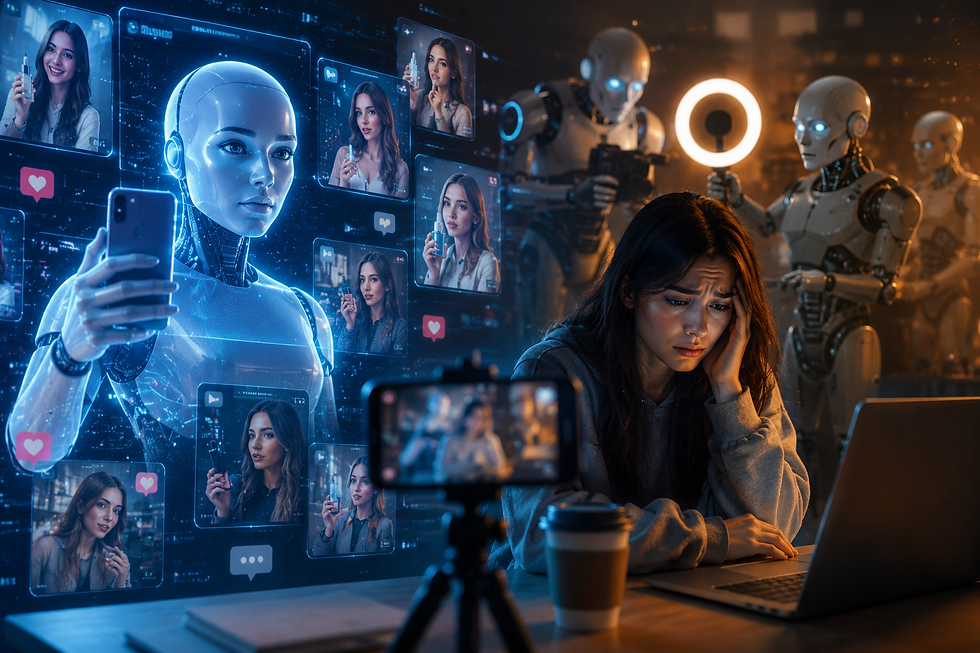
This shift creates a very real threat to many human creators.
A 2026 study from the National Bureau of Economic Research found that after generative AI tools entered creative platforms, many human illustrators experienced declines in uploads, visibility, and audience attention. (NBER)
Another academic analysis found that AI drastically lowers content production costs, increases market saturation, and creates a “winner-takes-all” effect where visibility becomes harder for average creators to achieve. (arXiv)
This matters because social media algorithms reward:
Volume
Consistency
Speed
Testing variations at scale
AI excels at all four.
That means:
Smaller creators may struggle to compete
Generic influencers may become replaceable
Commodity-style content may collapse in value
Brands may prioritize scalable AI assets over expensive creators
In simple terms:
If a creator’s entire value proposition is:
Looking attractive
Posting basic lifestyle content
Repeating trends
Reading scripted promotions
AI can likely replicate that.
And brands know it.
But Human Creators Still Have a Major Advantage
Despite the rapid rise of AI UGC, authenticity still matters enormously.
Consumer trust in AI influencers remains mixed.
Studies show:
Many consumers still distrust fully AI-generated influencers
Nearly half of surveyed consumers expressed discomfort with brands using AI influencers
96% of major brands surveyed expressed concerns around authenticity and consumer trust (Sprout Social)
Why?
Because humans connect emotionally with:
Real experiences
Real struggles
Real stories
Real emotions
Real social proof
AI can simulate emotion.
But lived human experience still carries credibility.
This is especially true in niches involving:
Travel
Fitness
Entrepreneurship
Relationships
Mental health
Lifestyle
Adventure
Hospitality
Community experiences
People still want recommendations from someone who actually lived the experience.
That is difficult for AI to fully replace.
The Future Will Likely Become Hybrid
The most likely outcome is not “AI replaces humans completely.”
The future is hybrid.
The creators who dominate the next decade will probably be:
Real humans
Using AI aggressively
Producing content faster
Scaling their personal brands
Automating repetitive tasks
Expanding into multi-platform ecosystems
AI becomes a force multiplier.
Not necessarily a total replacement.
Smart creators are already using AI for:
Script generation
Video editing
Thumbnail creation
Caption writing
Voice cloning
Translation
Content repurposing
AI avatars
Automated posting
Audience analysis
This allows creators to operate like media companies instead of individuals.
The creators who refuse AI may struggle.
The creators who master AI could become exponentially more productive.
The Bigger Risk: “AI Content Saturation”
Another major issue is content overload.
The internet is rapidly becoming flooded with:
AI-generated videos
AI-generated blogs
AI-generated images
AI-generated personalities
AI-generated commentary
Some experts now refer to low-quality AI content as “AI slop.” (The Guardian)
As content volume explodes, human attention becomes even more valuable.
This creates a paradox:
AI makes content easier to create…
But harder to stand out.
That means creators who can generate:
Trust
Real-world engagement
Authentic experiences
Community participation
Offline influence
may become even more valuable.
Where TripTips Fits Into This New AI Creator Economy
This is where TripTips becomes strategically powerful.
TripTips is positioned at the intersection of:
Real-world commerce
Referral marketing
Creator monetization
Local business discovery
Experiential marketing
And that matters because AI cannot physically replace real human experiences.
Scenario 1: If AI Replaces Large Portions of Influencer Marketing
If brands increasingly shift toward AI influencers, many human creators will need new monetization models.
Traditional sponsorship deals may decline.
Algorithms may become saturated.
Organic reach may continue shrinking.
In that environment, TripTips offers creators:
Performance-based monetization
Referral commissions
Real-world transaction tracking
Passive income from actual customer purchases
Local business partnerships
Independent revenue streams outside social algorithms
Instead of relying purely on:
Views
Likes
Ad revenue
Brand sponsorships
Creators can monetize actual purchasing behavior.
That is significantly more durable.
TripTips essentially transforms creators into:
Performance marketers
Experience curators
Local discovery engines
Revenue-driving affiliates
That model is much harder for AI alone to replicate.
Scenario 2: Human Creators Use AI to Scale Faster
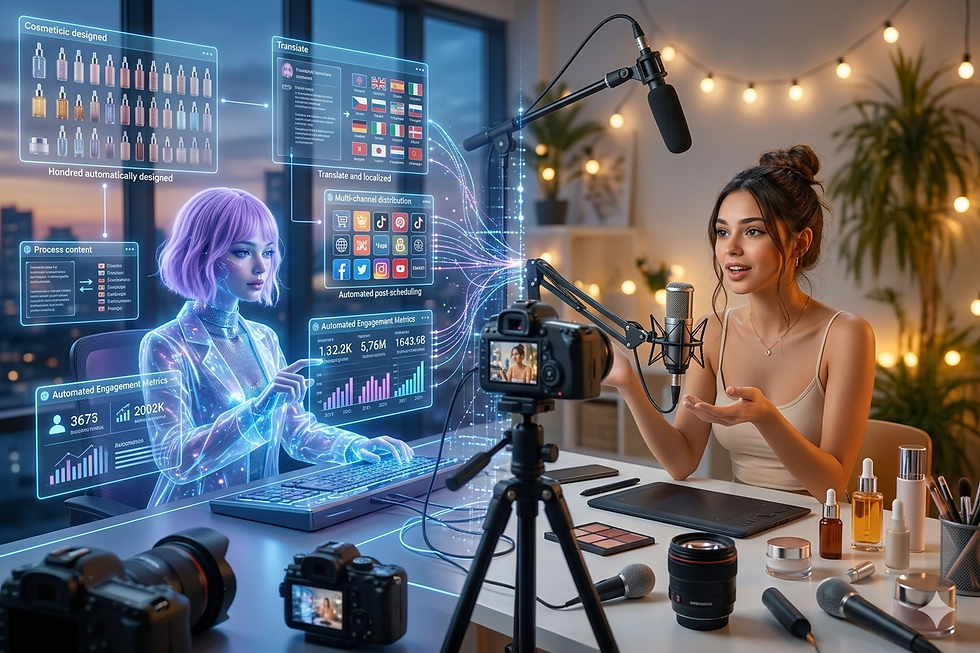
This is probably the bigger opportunity.
Imagine a creator using AI to:
Generate 50 short-form videos weekly
Translate content into multiple languages
Create AI-assisted edits
Build automated campaigns
Produce higher output with smaller teams
Now combine that with TripTips.
The creator can:
Drive traffic to businesses
Earn referral commissions
Promote travel experiences
Monetize nightlife recommendations
Monetize tourism content
Monetize local discoveries
Monetize community engagement
TripTips becomes the monetization infrastructure behind creator influence.
AI helps scale the content.
TripTips helps monetize the attention.
That combination is extremely powerful.
Why Human Experiences Still Matter
The creator economy is moving toward experiential influence.
People increasingly value:
Experiences
Recommendations
Travel
Social proof
Lifestyle validation
Community participation
AI can generate synthetic content.
But AI cannot physically:
Go to a nightclub
Attend a festival
Experience a restaurant
Travel somewhere
Build genuine social relationships
Real-life experiences still create emotional trust.
TripTips directly monetizes those experiences.
That creates long-term strategic relevance.
Final Thoughts
AI UGC content is not a temporary trend.
It is a structural transformation of the creator economy.
Some creators will absolutely be displaced.
Especially those producing generic, repetitive, low-authenticity content.
But creators who:
Build trust
Create real experiences
Develop communities
Learn AI tools
Monetize performance
Diversify revenue streams
could become significantly more powerful than creators from the previous era.
The next generation of creators will likely look less like influencers…
and more like scalable media businesses powered by AI.
TripTips fits directly into that future because it connects:
digital influence
real-world commerce
referral marketing
experiential discovery
creator monetization
In an internet increasingly flooded with synthetic content, platforms that connect digital attention to real-world experiences may become even more valuable.


Comments